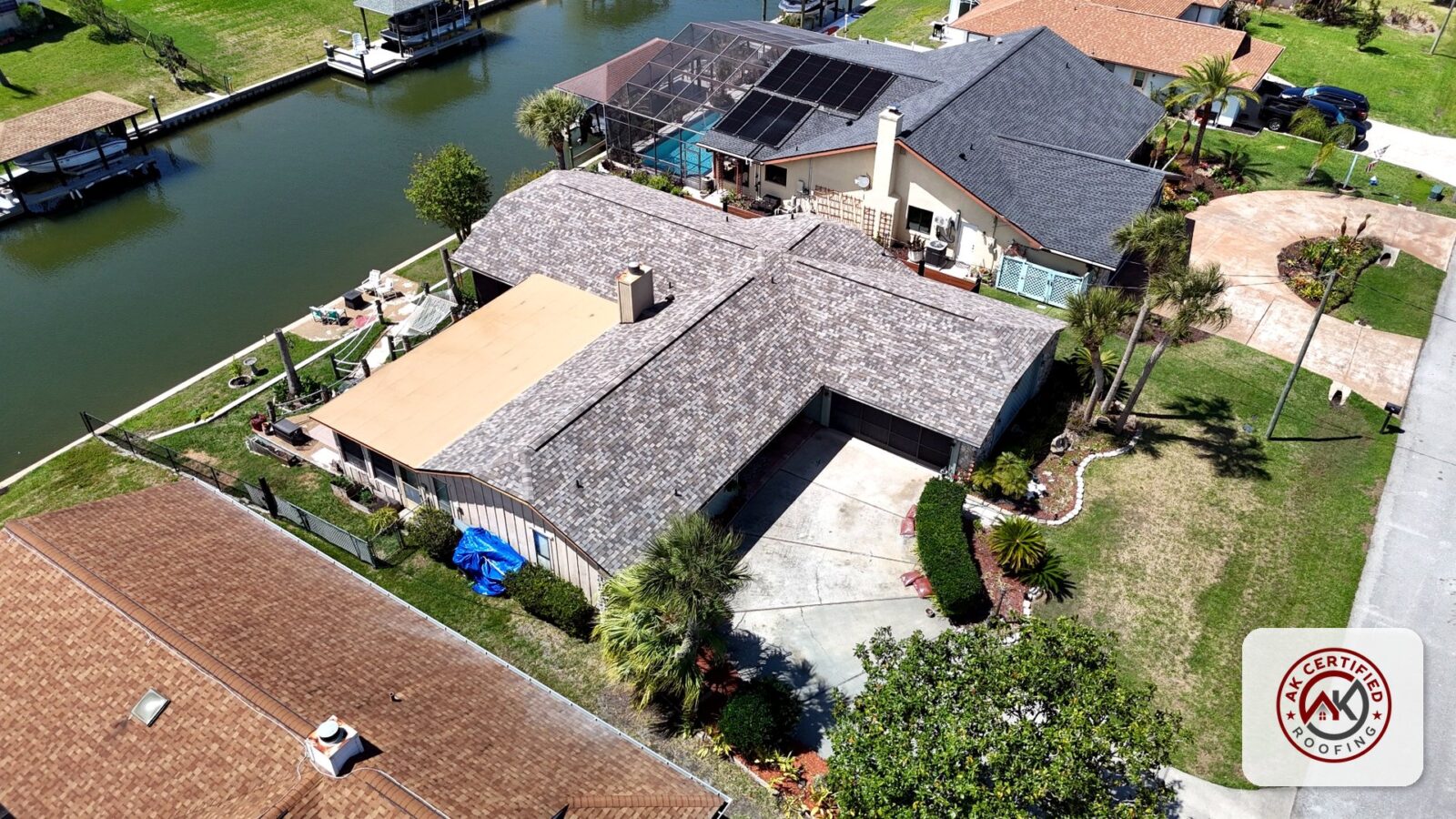
You walked outside after the storm and there are shingles on the grass. First thing: that is not automatically a new roof. One or two shingles blown off roof edges, on a roof with plenty of life left, is usually a straightforward repair. But the spot they came from is open right now, and Florida does not wait long between rains. Take photos of the shingles where they landed and the roof from the ground for your own records, note the date, and stay on the ground. Do not climb up there. Wet decking and loose footing are how people get hurt. Here is what blown off shingles actually mean, why the opening is the urgent part, and what we do when we repair one.
What shingles in the yard actually mean (and what they don’t)
Pick one up and look at it before you do anything else. The piece in your hand tells most of the story.
A whole tab, a clean rectangle with a straight top edge, means wind broke the seal and peeled the shingle until it let go at the nail line. That usually points to a sealant strip that had already released, from age or from a shingle that never bonded right. The roof around it may still be solid.
A torn piece with a ragged edge is different. The shingle ripped before the seal gave up, and shingles only rip like that once they have gone brittle. A brittle shingle rarely travels alone. Its neighbors came off the same line and have baked under the same sun.
What shingles in the yard do not mean: an automatic new roof. One clean tab off a roof with years left is a repair. A yard scattered with torn, curled, granule-bald pieces off an old roof is a different conversation.
Photos to take for your own records before anything moves
Before you clean up, take five minutes with your phone.
- The shingles where they landed, one wide shot and one close up.
- Each side of the roof you can see from the ground. Use the zoom, not a ladder.
- Anything else the wind moved: ridge caps, pieces of flashing, gutter sections, fence panels.
- The date and the name of the storm if it had one. Most phones stamp photos automatically, but write it down too.
Keep everything with your house records. If you sell the home, schedule a repair, or just want a clean timeline of what happened and when, you will be glad these exist.
Why the open spot matters more than the shingles on the grass
Here is the part people underestimate. A shingle is armor in layers. Granules block sunlight. The asphalt under them sheds water. The mat under the asphalt holds the whole thing together. When a shingle leaves, whatever sat beneath it becomes the surface of your roof, and it was never designed for that job.
Sometimes that is the top of the shingle in the course below. Sometimes it is bare underlayment. Either way, the exposed spot has no granule armor, so Florida sun starts breaking it down right away, and every rain after that gets a clear shot at nail heads and seams that were built to stay covered. Water that finds a way in wets the decking, and wet decking passes moisture along framing, which is why the ceiling stain often shows up nowhere near the missing shingle.
So the problem is not the shingle on the grass. It is the small square of roof it came from, which is now running on backup. Backup layers lose a little more of that fight with every sunny day and every shower.
Stay off the roof: what wet decking does to homeowners
We mean it. Shingles stay slick after rain, and a storm that pulled some shingles loose may have loosened others that feel solid right up until they are not. Decking that took on water can flex or go soft underfoot, and you cannot tell which sheet is which by looking. We climb roofs for a living, with the right footwear and anchor points, and we still treat a roof after a storm with respect. Ground level and a zoom lens cover everything you need.
When a few missing shingles are a simple repair
Most of the time this story ends quietly. Repairing blown off shingles means removing the damaged pieces, weaving new shingles into the surrounding courses, hand sealing them so they are bonded from day one, and checking the shingles around the patch while we are up there, because wind that took one usually stressed its neighbors. The work is backed by our 10-year workmanship warranty, and you can see how we handle it on our roof repair page.
One honest note about matching. Shingle colors fade in Florida sun, and manufacturers retire colors and whole product lines. New shingles set into a roof that has been fading for ten years will read a shade different up close. We match as closely as current products allow, and we tell you what to expect before we start. A repair’s job is to close the roof and hold, and a good one does exactly that.
When it is not simple, we say so. If the pieces in your yard are torn and brittle, or you are picking up shingles after every storm, patching is spending money on a roof that is telling you something. The smarter move at that point is a plan and a timeline, and we will lay out both.
If you need signed documentation for a closing or purchase
One more thing worth knowing, because it comes up. If you are buying or selling a home and the transaction needs a roofer’s signature on the roof’s condition, that is a separate product from a repair visit. We provide a signed condition report, $250 for a one story home and $350 for a two story, written for a closing or purchase. Repair and replacement estimates stay free, and most storm situations never need the signed report. It exists for the moment the paperwork requires one.
For everything else the next step is simple. Call or text (386) 302-9063 and a roofer answers, 7-7 Mon-Sat. We will put eyes on the roof and hand you a free written estimate with photos of exactly what we found. AK Certified Roofing is licensed and insured, FL CCC1331606, and an Owens Corning Platinum Preferred contractor. If the storm left shingles blown off roof sections, get the opening closed before the next rain finds it.
