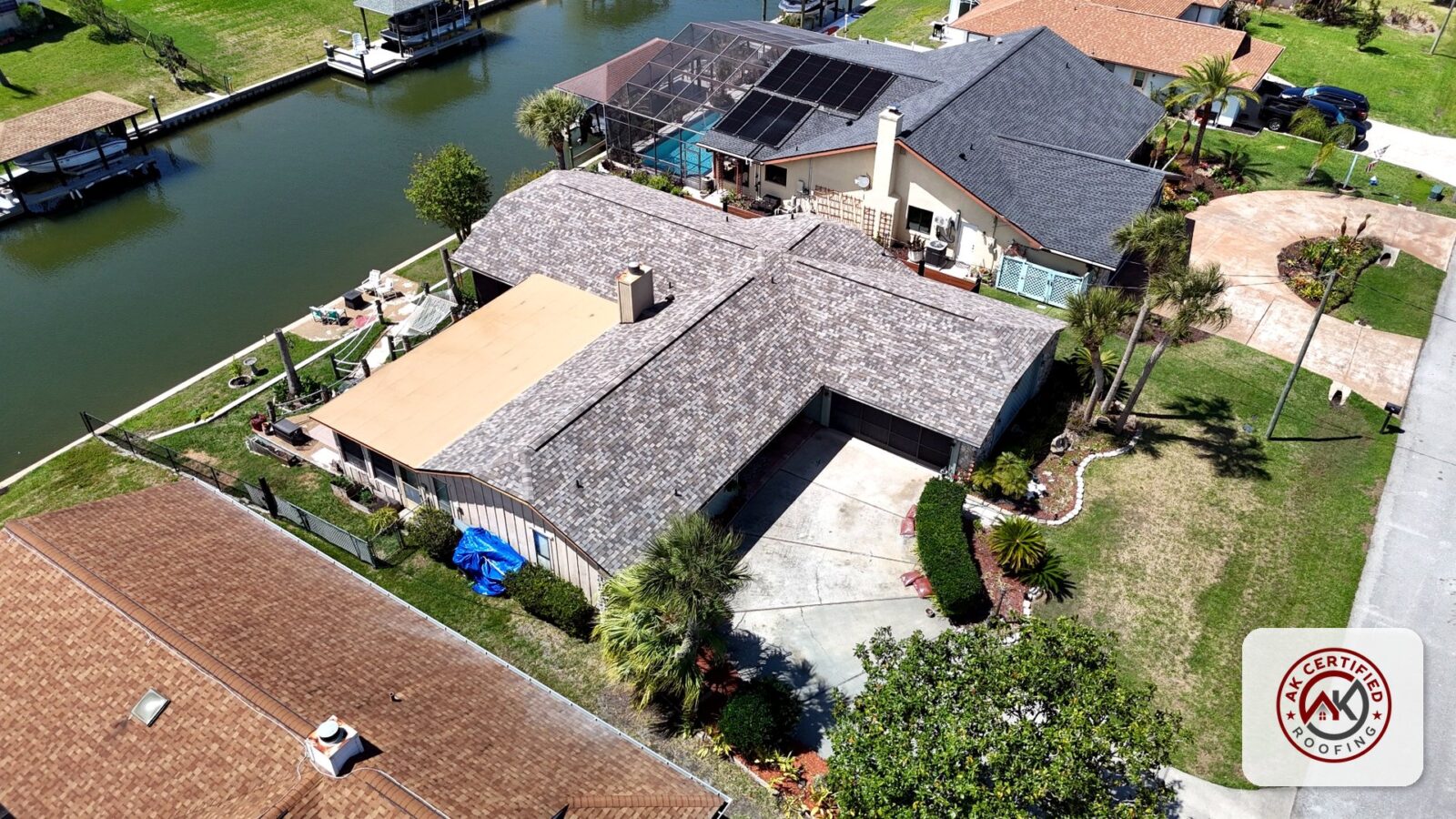
Clean your gutters and find what looks like coarse black sand in the bottom? Those are granules off your shingles. Finding shingle granules in gutters does not automatically mean trouble. Every asphalt shingle sheds some, and a brand new roof sheds extra its first year. What matters is quantity and trend. A handful after a heavy storm on a five year old roof is normal wear. Half an inch of grit in every gutter run on a fifteen year old roof is the roof telling you where it is in its life. Here is how to judge what you are seeing, what to check next, and how to plan ahead instead of getting surprised.
Normal shedding vs a roof wearing out
Granules are the crushed stone coating pressed into the top of every asphalt shingle at the factory. They give the shingle its color, and more importantly they shield the asphalt underneath from the sun. Some of those granules never fully bond. A new roof sheds those loose extras over its first year or so. It can look alarming in the gutters, but it tapers off on its own.
A roof wearing out is a different pattern. The shedding does not taper. It shows up after every rain, not just the rough ones. The granules keep coming year after year, and the amount grows. That steady, growing loss means the bond between the stone and the asphalt is failing across the roof, not just a few loose extras working free.
Storms muddy the picture. A hard rain scrubs loose granules off any roof. One heavy cleanout after a storm is a data point, not a verdict. Three heavy cleanouts in a row is a trend.
How to read what is in your gutters: amount, age, trend
Your gutter cleanout is a free measuring stick. Three things to note each time.
Amount. A light dusting mixed in with leaves and dirt is background noise. Grit deep enough to scoop is a real reading.
Age. The same bucket of granules means different things on different roofs. Heavy shedding in year one is normal settling. The same shedding in year fifteen is the roof running out of coating to lose.
Trend. This is the one most people skip. Take a photo of what you scoop out at each cleanout, same gutter run each time. If each photo shows more grit than the last, the roof is losing its coating faster, and that curve does not reverse.
Date the photos and you have a record that costs nothing.
What granule loss does to shingle life in Florida sun
The granules are not decoration. They are the shingle’s sunscreen. Underneath them is an asphalt mat, and asphalt does not tolerate direct sun. UV light dries it out, makes it brittle, and opens fine cracks that let water start working on the layers below. A shingle that loses its granules is exposed to the one thing it was built to be shielded from.
Florida sun works on an exposed mat all year. A bald shingle up north gets a break every winter. A bald shingle here does not. Once the coating goes, the aging speeds up, which is why the trend in your gutters matters more than any single cleanout.
You can check for bald spots from the ground. Stand back where you can see a whole slope in good light. Look for patches that are darker or shinier than the shingles around them, especially on the south and west faces that catch the most sun. Shiny means exposed asphalt catching light. After a rain, look at the ground under your downspouts too. A spreading fan of granules there is the roof telling on itself. No ladder needed, and you should not climb up regardless. Ground and gutters tell you plenty.
Roof age math: when to start planning instead of reacting
Put the age of the roof next to what the gutters are telling you and the picture usually gets clear.
A newer roof shedding after a storm needs nothing but a note on the calendar. A roof in its middle years shedding lightly is ordinary wear worth watching. An older roof with heavy, growing shedding and visible bald patches is not going to un-age, and the useful question changes from whether to act to when.
Where the loss shows up matters too. Granule loss concentrated in one spot, like a valley, below a vent, or along one edge, can be a localized problem with a localized fix. Water running the same path for years wears the shingles under it. That can be a repair conversation. Loss spread evenly across the whole roof on an older home is the shingles aging as a group, and patching one area does not change what the rest of the field is doing. That is a roof replacement conversation, and having it early is the whole advantage.
Planning ahead is the difference between choosing your roof and having it chosen for you by a leak in the wet season.
Replacing on your schedule, not the roof’s (financing choices exist)
Nobody wakes up wanting to buy a roof. But there is a real difference between replacing a roof on your terms and replacing one in an emergency. On your schedule, you pick the season, compare shingle lines and colors, ask your questions, and plan the cost. Several financing choices exist, and we walk through them at the estimate so the timing works for your budget. In an emergency, the ceiling is staining, the tarps are up, and every decision is rushed.
The gutter reading is what buys you that runway. A roof that is shedding heavily but not yet leaking may still give you time to plan. If it does, we say so and tell you what to watch. When it is time, we install as an Owens Corning Platinum Preferred contractor and back the work with a 10-year workmanship warranty.
Get a free written estimate with photos
If your gutters are filling with grit, or you can see bald patches from the yard, have us put eyes on it. We will photograph what we find and hand you a free written estimate with photos, so you see exactly what we saw. If it is a repair, we will say repair. If it is time to plan a replacement, we will show you why and lay out the choices.
If you keep finding shingle granules in gutters after every rain, or you can see bald patches from the yard, have us put eyes on it. Call or text (386) 302-9063. A roofer answers 7-7 Mon-Sat. AK Certified Roofing, Palm Coast. FL CCC1331606, licensed and insured.
