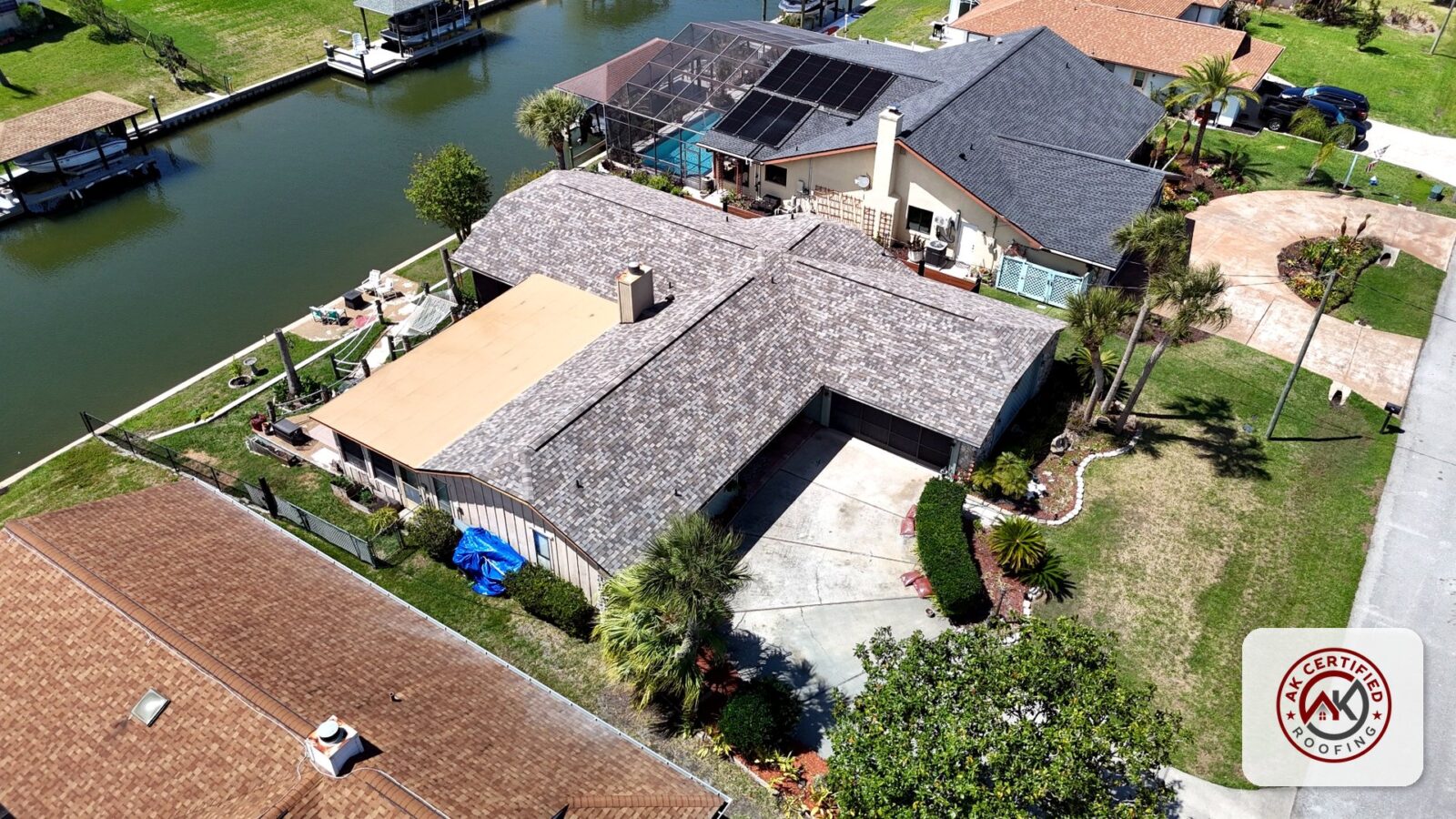
If your roof leaks in heavy rain but never in a normal shower, you are not imagining it. The opening is real. Light rain falls straight down and your shingles shed it the way they were built to. Hard rain arrives with volume and wind behind it, and that combination pushes water into places gravity never takes it. So the ceiling stains, the storm passes, the mark dries, and the urgency fades until the next big one. Meanwhile the wood around that entry point wets and dries with every storm, and rot does not take breaks. Here is why a roof can stay dry for months and then leak in one specific storm, and how we find the opening.
Why hard rain finds openings light rain never touches
Three things change in a hard storm, and any one of them can turn a dry roof into a wet ceiling.
Volume. Every roof has a weakest detail. A flashing lap that sheds almost every rain still has a small gap in it. In a quiet shower the water rides past. In a downpour the roof carries far more water at once, valleys run full, and that same gap takes on water faster than it can drain.
Wind direction. Rain that falls straight down never touches some parts of a roof. Rain pushed sideways from the east works on laps and edges that face east. A storm out of the south works on different ones. That is why a roof can leak in one storm and skip the next three. The opening only sees water when the weather comes from its direction.
Gutter backup. A gutter packed with debris, or simply outrun by the storm, backs water up over its back edge and behind the drip edge. From there it wets the fascia and the edge of the decking.
The usual suspects: flashing laps, nail pops, vents, valleys
Flashing laps. Step flashing along walls and chimneys works by overlapping downhill, the same way shingles do. Water running downhill never sees the joint. Water driven sideways or uphill slides straight into it. These leaks tend to show on ceilings near a wall, a chimney, or where a roof meets a second story.
Nail pops. A nail that backs out of the decking lifts a small tent in the shingle above it. That tent sits above the normal water line, so light rain slides around it. A heavy sheet of water rides right over the hole. One backed-out nail can stain a whole ceiling.
Vents. Plumbing boots crack in Florida sun. Ridge vents and off-ridge vents are built to move air, which means a hard sideways rain can push water in where air normally goes out.
Valleys. A valley carries the water from two roof planes at once, so in a storm it moves more water than any other line on the roof. Leaves sitting in a valley dam that flow and send it sideways under the shingles next to it.
Why living with an intermittent leak costs more than fixing it
An intermittent leak is easy to live with. It shows up a few times a year, dries out, and lets you forget it. That quiet stretch is the expensive part. Every hard storm wets the decking around the entry point, the insulation under it, and the back of your drywall. Wood that wets and dries over and over rots, and it rots from the top down where you never see it. A problem that starts as a simple flashing rework can grow into decking replacement, new insulation, and drywall repair if it runs for a few years.
The dry weeks between storms are exactly when to fix it. The roof is safe to work on, the schedule is yours instead of the weather’s, and the repair is still small. This is the everyday work behind our roof leak repair in Palm Coast service, and the earlier we see it, the simpler it stays.
How we track down a leak that will not show itself
Intermittent leaks are the hardest kind to trace because the evidence is dry by the time anyone looks, and the stain is almost never under the hole. Water gets in high, runs along a rafter or the top of the decking, and drops wherever it lets go. The mark on your drywall can be ten feet from the entry point.
So we work backwards. First we listen. Which storms leaked, which ones did not, and which way the wind was blowing tell us which side of the roof to start on. Then we read the attic: water tracks on the rafters, rust on the nail tips, dark patches on the decking. Those tracks point uphill toward the entry. Up top we check the details that sit above that track, the flashing laps, the boots, the nail lines, the valley edges. And when a roof leaks in heavy rain but refuses to show itself any other way, we run a controlled water test, working uphill one section at a time with eyes in the attic, so the moment water shows we know exactly which detail let it in.
The fix, backed by a 10-year workmanship warranty
Caulk is not a fix. Sealant smeared over a flashing lap or a nail pop dries, shrinks, and cracks, and the leak comes back with the next hard storm. A real repair reworks the detail so it sheds water on its own again. Shingles come up, the flashing gets replaced and lapped correctly, backed-out fasteners get pulled and reset with new shingles over them, a cracked boot gets replaced instead of coated, and a failed valley gets cleared and reworked.
AK Certified Roofing is licensed and insured, FL CCC1331606, and an Owens Corning Platinum Preferred contractor. Our repair work is backed by a 10-year workmanship warranty. If the honest answer is that the roof is near the end of its life, we say that plainly and show you the photos that prove it.
Next step: a free written estimate with photos
If your roof leaks in heavy rain and stays dry the rest of the year, the opening is already up there. Find it during the dry weeks, not during the next storm. We will put eyes on it and give you a free written estimate with photos: what we found, where the water is getting in, and exactly what the fix costs. Call (386) 302-9063. A roofer answers the phone 7-7 Mon-Sat. If we can’t help, we say so.
